A Case for Dividing Uttar Pradesh into Smaller States
- Representation Gap: The average population per MLA in Uttar Pradesh is almost three times higher than in well-governed states like Keralam, leading to weaker representation.
- Administrative Burden: The sheer administrative and political weight of Uttar Pradesh is so large that it dwarfs many sovereign countries, making governance complex.
- Accessibility Issues: A common citizen from Ballia has to travel more than 350 km to reach the capital, Lucknow. Similarly, a citizen from Saharanpur travels around 500 km to the capital and nearly 700 km to access the High Court at Prayagraj.
- Overburdened District Administration: Several districts—such as Prayagraj district, Jaunpur district, and Lucknow district—have populations exceeding 4 million, which is difficult to manage under a single district administration.
- Regional Development Imbalance: The development deficit in Eastern Uttar Pradesh can be better addressed if governance is decentralised and resources are more region-specific, rather than being concentrated in Western UP.
- Suppressed Regional Voices: Uttar Pradesh has several regional political parties, such as Rashtriya Lok Dal and Suheldev Bharatiya Samaj Party, which raise local concerns but often get subdued due to the large size of the legislature.
- Distinct Regional Identity: The Bundelkhand region has a unique socio-cultural identity, but it is divided between Uttar Pradesh and Madhya Pradesh. There is a long-standing demand for a separate Bundelkhand state.
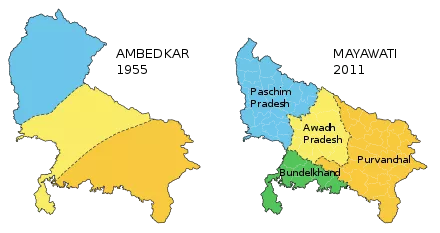
- Precedent Exists: The idea is not new—former Chief Minister Mayawati had proposed dividing Uttar Pradesh into four smaller states.
- Population Dynamics: If Uttar Pradesh were a country, it would be the 7th largest in the world by population, highlighting the scale of governance challenges.
- Historical Precedents: Before the British annexation of Awadh, the region was governed by multiple autonomous entities, such as Awadh and Banaras. The British consolidated these regions into the “United Provinces”, which later became Uttar Pradesh—primarily for administrative convenience, not cultural or regional coherence.
- Delimitation and Federalism Debate: If Uttar Pradesh were divided into four smaller states, each with around 20 Lok Sabha seats, the excessive concentration of political power would be reduced. This would ensure a more balanced federal structure, where all states have a relatively equal say in national politics.
- Power Dynamics and Social Contract Angle: The 91st Constitutional Amendment Act 2003 caps the Council of Ministers (CoM) at 15% of the legislative assembly strength (earlier debates often referred to lower limits in practice). In a large state like Uttar Pradesh, this results in a limited number of ministers (around 60), concentrating significant political and financial power in the hands of a few.
- Development Angle: It is often argued that Eastern Uttar Pradesh lacks a strong industrial base. However, similar concerns existed in newly formed states like Uttarakhand, Chhattisgarh, and Andhra Pradesh (post-bifurcation). These states have demonstrated that development deficits can be addressed with focused governance. Moreover, past precedents show that the Union government provides financial support and special packages for the development of newly created states.
- Scholarly Argument: In 1955, Dr BR Ambedkar proposed the idea of splitting UP into three states through his book, ‘Thoughts On Linguistic States’. He emphasised the creation of three states, with Meerut as the capital of the Western Region, Allahabad as the capital of the Eastern Region and Kanpur as the capital of the Central Region. Dr Ambedkar on splitting UP into 3 states had said, “Each of these three States should have a population of approximately two crores, which should be regarded as the standard size of population for a State to administer effectively”.
Written by Vivek Maurya
← All Posts